Start With the Game, Not the Channel
Write a specific working player hypothesis using the game's play pattern, likely player motivations, and behaviors to investigate before choosing a channel.
Example · A tactical co-op game whose players trade strategies; A cozy simulation game whose players share screenshots, stories, or mods
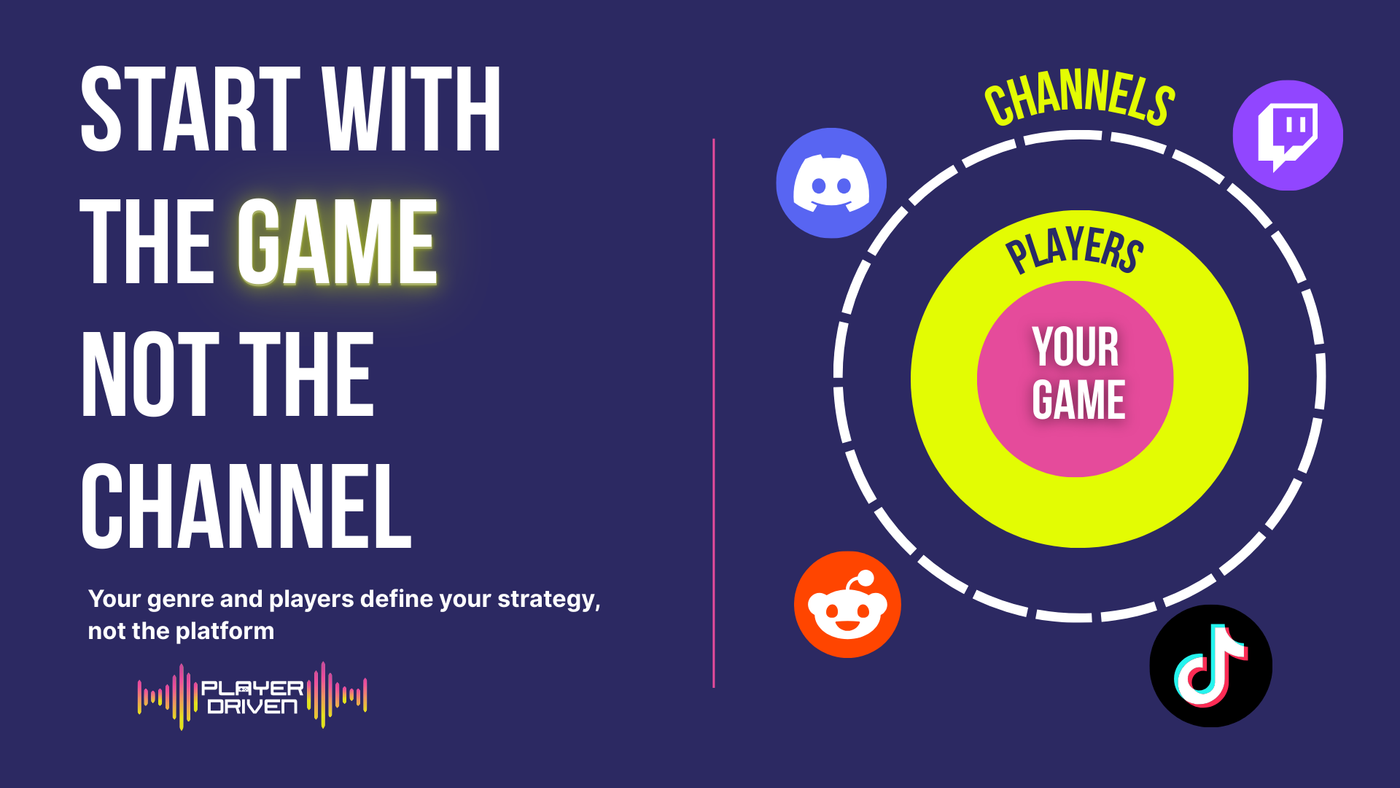
The fastest way to create scattered community work is to begin with a list of channels. A team sees another game using a server, short-form video, a forum, or a creator program and assumes the same mix will fit its own players. The team then spends limited time maintaining several places without a clear reason for being in any of them.
Start with the game instead. Its play pattern, emotional promise, social structure, and likely player motivations give you better questions to investigate. They do not provide a final answer, but they make your search specific enough to test.
Build a working player hypothesis
A working player hypothesis is not a demographic profile presented as fact. It is a clear statement about the people most likely to value the experience you are making and the behaviors you expect to observe around that experience.
Use three ingredients:
- Game and play pattern: What does the player repeatedly do? Is the experience tactical, expressive, social, exploratory, competitive, creative, relaxing, or some combination?
- Likely motivation: What might make this experience meaningful? Possibilities include mastery, belonging, self-expression, discovery, challenge, collection, collaboration, or recognition.
- Observable behavior: What would people do if that motivation matters to them? They might trade strategies, compare builds, share screenshots, tell stories, make guides, organize sessions, create mods, or discuss design choices.
Turn those ingredients into one sentence:
Players who enjoy [play pattern] may value [motivation], so I expect to find them [observable behavior] in or around [candidate kinds of spaces].
The words "may" and "expect" matter. They keep the statement testable. You are naming an informed assumption, not announcing a truth about a group of people.
Let game type generate questions
Game type can help you think, but it should not become a platform shortcut. A tactical co-op game might lead you to look for strategy exchange, team formation, and post-match analysis. A cozy simulation game might lead you to look for screenshots, stories, customization, guides, or mods. Those behaviors could appear in several kinds of spaces, and the most useful space can differ by game, audience, region, development stage, and team capacity.
Ask questions such as:
- Does the game give players something worth discussing between play sessions?
- Does it produce artifacts people may want to share, such as clips, builds, maps, stories, or creations?
- Do players need other people to learn, coordinate, compete, or make progress?
- Is the experience connected to an existing genre, hobby, creator scene, modding scene, or local community?
- What words would a likely player use to describe the need this game serves?
The answers point toward behaviors and adjacent communities. They do not yet justify a permanent channel commitment.
Find candidate campfires
Think of a campfire as a place where relevant people already return to talk, help, create, organize, or make meaning together. A campfire might be centered on a genre, a comparable game, a creator, a modding practice, a live event, a hobby, or a problem your game helps players solve.
At this stage, make a short candidate list. One to three plausible campfires is enough for a first research pass. A small list forces you to explain why each space belongs on it.
For every candidate, write:
- Who appears to gather there?
- What do they seem to care about?
- What do they do with one another, not just with the account or organizer?
- Which part is observation, and which part is still your inference?
This distinction keeps a vivid example from turning into a broad claim. One popular post may show that a topic can attract attention. It does not, by itself, show that people will return, form relationships, contribute, or welcome a studio's participation.
Your move
Write one player hypothesis for your game or a practice game. Name the game type or play pattern, one or two likely motivations, and at least one behavior you would expect to observe. Then list up to three candidate campfires where you could investigate that hypothesis.
Do not choose your focus campfire or Hunt Zone yet. First, look for evidence that the campfire has signs of life.