Find Where Your Players Gather
Stop choosing community channels by habit. Define your likely players, find where they already gather, read real signs of life, and choose one focused test.
- 01LESSON 1 · 5 MIN01LESSON 1·CP-013-L1·5 MIN
Start With the Game, Not the Channel
Write a specific working player hypothesis using the game's play pattern, likely player motivations, and behaviors to investigate before choosing a channel.
Start With the Game, Not the Channel
Write a specific working player hypothesis using the game's play pattern, likely player motivations, and behaviors to investigate before choosing a channel.
EXAMPLE · A tactical co-op game whose players trade strategies; A cozy simulation game whose players share screenshots, stories, or mods
The fastest way to create scattered community work is to begin with a list of channels. A team sees another game using a server, short-form video, a forum, or a creator program and assumes the same mix will fit its own players. The team then spends limited time maintaining several places without a clear reason for being in any of them.
Start with the game instead. Its play pattern, emotional promise, social structure, and likely player motivations give you better questions to investigate. They do not provide a final answer, but they make your search specific enough to test.
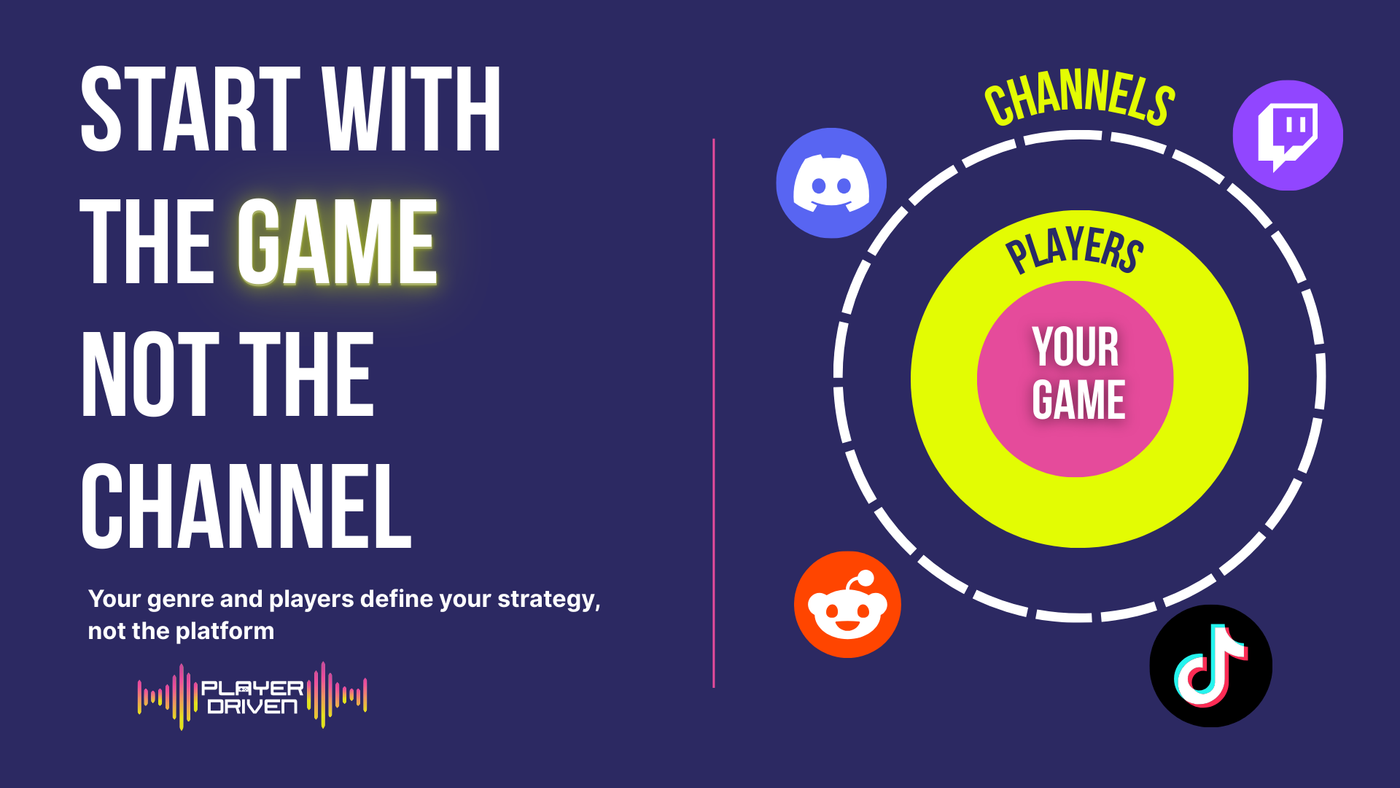
Start with the game and expected player behavior before selecting channels. Build a working player hypothesis
A working player hypothesis is not a demographic profile presented as fact. It is a clear statement about the people most likely to value the experience you are making and the behaviors you expect to observe around that experience.
Use three ingredients:
- Game and play pattern: What does the player repeatedly do? Is the experience tactical, expressive, social, exploratory, competitive, creative, relaxing, or some combination?
- Likely motivation: What might make this experience meaningful? Possibilities include mastery, belonging, self-expression, discovery, challenge, collection, collaboration, or recognition.
- Observable behavior: What would people do if that motivation matters to them? They might trade strategies, compare builds, share screenshots, tell stories, make guides, organize sessions, create mods, or discuss design choices.
Turn those ingredients into one sentence:
Players who enjoy [play pattern] may value [motivation], so I expect to find them [observable behavior] in or around [candidate kinds of spaces].
The words "may" and "expect" matter. They keep the statement testable. You are naming an informed assumption, not announcing a truth about a group of people.
Let game type generate questions
Game type can help you think, but it should not become a platform shortcut. A tactical co-op game might lead you to look for strategy exchange, team formation, and post-match analysis. A cozy simulation game might lead you to look for screenshots, stories, customization, guides, or mods. Those behaviors could appear in several kinds of spaces, and the most useful space can differ by game, audience, region, development stage, and team capacity.
Ask questions such as:
- Does the game give players something worth discussing between play sessions?
- Does it produce artifacts people may want to share, such as clips, builds, maps, stories, or creations?
- Do players need other people to learn, coordinate, compete, or make progress?
- Is the experience connected to an existing genre, hobby, creator scene, modding scene, or local community?
- What words would a likely player use to describe the need this game serves?
The answers point toward behaviors and adjacent communities. They do not yet justify a permanent channel commitment.
Find candidate campfires
Think of a campfire as a place where relevant people already return to talk, help, create, organize, or make meaning together. A campfire might be centered on a genre, a comparable game, a creator, a modding practice, a live event, a hobby, or a problem your game helps players solve.
At this stage, make a short candidate list. One to three plausible campfires is enough for a first research pass. A small list forces you to explain why each space belongs on it.
For every candidate, write:
- Who appears to gather there?
- What do they seem to care about?
- What do they do with one another, not just with the account or organizer?
- Which part is observation, and which part is still your inference?
This distinction keeps a vivid example from turning into a broad claim. One popular post may show that a topic can attract attention. It does not, by itself, show that people will return, form relationships, contribute, or welcome a studio's participation.
Your move
Write one player hypothesis for your game or a practice game. Name the game type or play pattern, one or two likely motivations, and at least one behavior you would expect to observe. Then list up to three candidate campfires where you could investigate that hypothesis.
Do not choose your focus campfire or Hunt Zone yet. First, look for evidence that the campfire has signs of life.
↳ Your actionWrite a one-sentence player hypothesis and list one or two likely motivations.
- 02LESSON 2 · 5 MIN02LESSON 2·CP-013-L2·5 MIN
Find the Campfires and Read the Signals
Identify plausible player campfires and distinguish evidence of community vitality from reach alone.
Find the Campfires and Read the Signals
Identify plausible player campfires and distinguish evidence of community vitality from reach alone.
EXAMPLE · A small space where recurring participants help one another; A large announcement feed with reactions but little player-to-player conversation
A large audience is not the same as a living community. Views, reactions, downloads, and follower counts can tell you that content traveled or attracted attention. They are useful measures for some goals, but they do not show the full quality of interaction inside a space.
For this Hunt Map, look for three families of evidence: active conversation, recurring relationships, and player contribution.
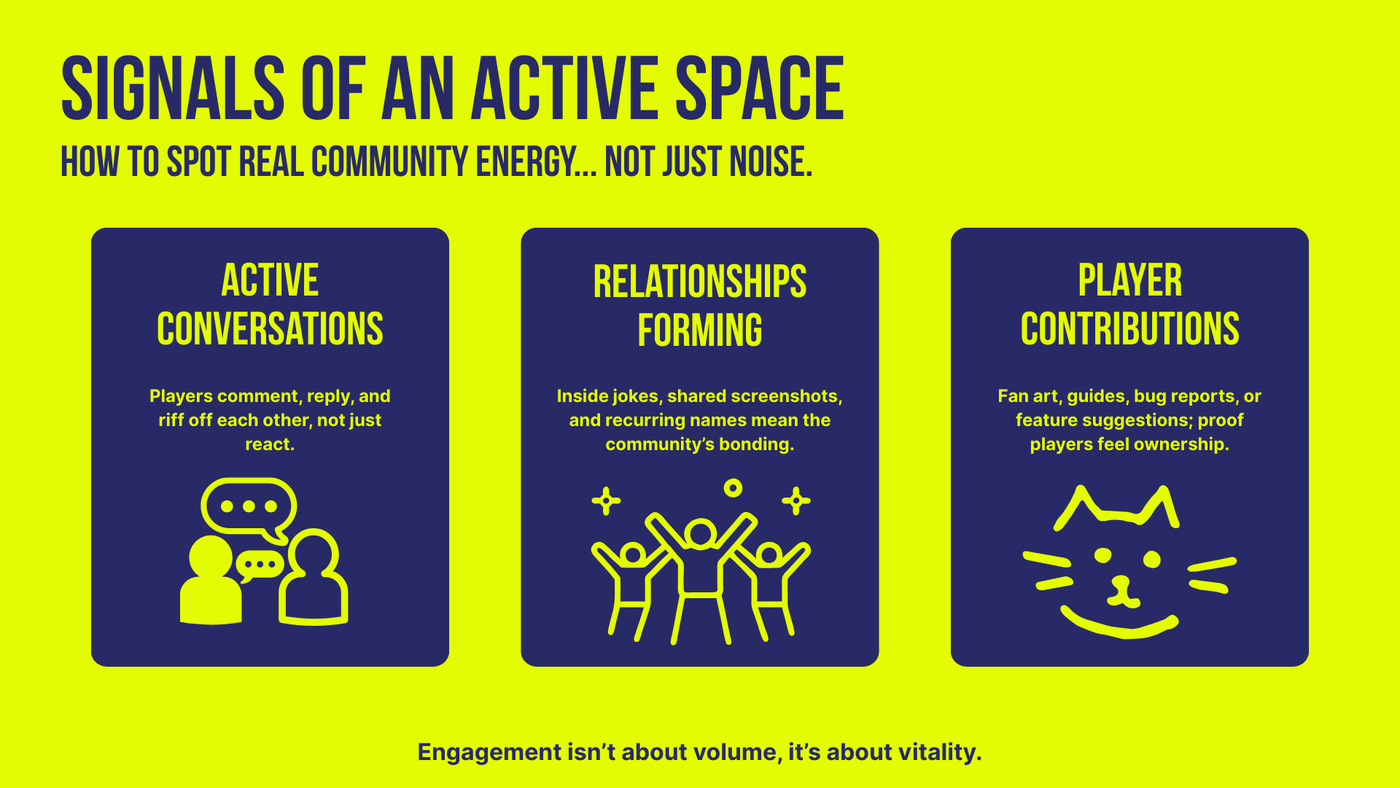
Use these as working evidence categories, not as a universal community score. Signal 1: active conversation
Active conversation goes beyond people responding to an announcement. Look for people replying to one another, asking follow-up questions, comparing experiences, disagreeing constructively, sharing context, or carrying an idea forward.
Useful questions include:
- Are most replies directed only at the organizer, or do participants talk with each other?
- Do questions receive useful answers?
- Does a topic develop over several exchanges?
- Do people return after the first reaction?
A fast stream of short reactions can still support a valid content goal. For community research, however, player-to-player exchange is stronger evidence that the space supports participation rather than only distribution.
Signal 2: recurring relationships
Communities gain continuity when people recognize one another and develop shared context. Look for recurring participants, informal helpers, references to earlier discussions, collaborative routines, and signs that newcomers can learn how the space works.
You do not need a large population to see this signal. A small group may have strong continuity, while a large audience may have very little interaction between members. The point is not that smaller is always better. The point is to judge the kind of activity against the outcome your team wants and the care it can provide.
Also look for stewardship. That may include moderators, organizers, creators, or community members who guide discussion, reinforce norms, answer questions, and make participation easier. The right cadence depends on the space. Avoid treating a fixed daily posting rule as a universal standard.
Signal 3: player contribution
Contribution shows that people are investing effort beyond a reaction. Depending on the game and community, contributions might include:
- Guides, FAQs, build notes, maps, or tutorials
- Fan art, screenshots, clips, stories, or memes
- Mods, tools, custom levels, challenges, or events
- Bug reports, accessibility observations, or structured feedback
- Suggestions that other members refine together
- Welcoming, mentoring, or organizing work
Not every healthy space will produce every kind of contribution. Look for the forms that make sense for the game and respect the norms of the space. When you later feature a contribution, ask permission where appropriate and give clear credit.
Keep a simple evidence log
Spend a bounded observation period with each candidate campfire. Record concrete examples instead of general impressions.
For each space, capture:
- Date or observation window
- One example of player-to-player conversation
- Any recurring participants or shared routines you notice
- One contribution, if present
- Evidence of stewardship or community norms
- A question you still cannot answer
Use public and appropriate information. Do not collect private member details, copy private messages, or enter non-public invite links into your Hunt Map. If you are already a member of a private community, follow its rules and describe patterns without identifying individuals.
Read weak and mixed signals carefully
Evidence is often incomplete. A space may be quiet because you observed it at the wrong time, because the relevant conversation happens elsewhere, or because the audience gathers around events instead of daily discussion. A burst of activity may reflect a launch or controversy rather than an ongoing pattern.
Treat missing evidence as a reason to keep the claim narrow. Write "I did not observe recurring conversation during this window" instead of "this community is inactive." Write "this clip generated questions about the mechanic" instead of "players want this feature."
This habit improves both community strategy and internal decision-making. Your teammates can see what was observed, what was inferred, and what needs another test.
Your move
Choose one to three candidate campfires from Lesson 1. For each, record one concrete signal you observed. If you have not observed the space yet, name the signal you will look for and set a short observation window.
Your evidence does not need to be impressive. It needs to be specific enough to support or challenge your player hypothesis.
↳ Your actionName one to three candidate campfires and record one signal observed, or one signal to look for, in each.
- 03LESSON 3 · 5 MIN03LESSON 3·CP-013-L3·5 MIN
Choose One Hunt Zone and Validate It
Choose a Primary, Growth, or Explore Hunt Zone using observed evidence, then define a bounded test with an observable expected result.
Choose One Hunt Zone and Validate It
Choose a Primary, Growth, or Explore Hunt Zone using observed evidence, then define a bounded test with an observable expected result.
EXAMPLE · A focused gameplay-clip test with active replies; A community feedback question tied to a real design choice; A player-contribution spotlight with permission and credit
Research becomes useful when it leads to a focused decision. A small team can rarely participate well in every plausible space at once. Choose a Hunt Zone based on the evidence you have, the purpose of your participation, and the capacity your team can sustain.
The three Hunt Zones are Primary, Growth, and Explore. They are working categories, not permanent labels and not scores of a community's worth.
Primary Hunt Zone
Choose Primary when you have the strongest relevant evidence and a credible way to participate consistently. You may see recurring player conversation, contributions, or a clear match between the space's interests and the experience your game offers.
Primary does not mean "post the most." It means this is the first place where you will listen, participate, test, and learn. Your team should be able to respond to people, follow the space's norms, and maintain the activity it starts.
Growth Hunt Zone
Choose Growth when the fit looks promising but the evidence or momentum is incomplete. There may be related conversations, a creator or organizer who reaches the right people, or a contribution pattern that your game could support. You need a focused test before increasing your commitment.
A Growth test might involve joining an existing discussion, collaborating on a small event, sharing a useful work-in-progress artifact, or asking for feedback on a real design question. The exact action should fit the community's rules and expectations.
Explore Hunt Zone
Choose Explore when the connection is plausible but early or weakly evidenced. You are not rejecting the space. You are deciding to observe it at a low level while you invest more effort elsewhere.
Exploration may include following public conversations, noting relevant creators or events, or revisiting the space after a milestone. Set a review date so "Explore" does not become an indefinite list of channels nobody evaluates.
Choose depth as a practical constraint
For a small team, deeper participation in one well-supported space is often more useful than shallow activity across many spaces. That is a constraint, not a universal law. A broad distribution campaign may still fit a reach objective, and different team members may already have the capacity to care for multiple communities.
For this exercise, choose one focus campfire and assign its current Hunt Zone: Primary, Growth, or Explore. The category should reflect the evidence and team capacity you have now, not aspiration or the community's worth.
Write the reason for each choice using evidence:
I chose [space] as Primary because I observed [specific conversation, relationship, or contribution signal], and our team can [credible participation behavior] during [time window].
Avoid reasons based only on habit, audience size, or the fact that another studio is present.
Validate an approach, not a permanent channel
Your first test should answer a useful question about how to participate. Keep it bounded so you can review the result without treating one attempt as a final verdict.
Define five parts:
- Action: What will you do?
- Space: Where will you do it, and what local norms apply?
- Window: When will you observe the response?
- Expected result: What concrete signal would support the hypothesis?
- Next decision: What would make you continue, adjust, or stop?
Examples of suitable actions include:
- Share a short gameplay clip and reply to every substantive comment you can responsibly address.
- Join an existing discussion and ask one focused question that contributes to the topic.
- Run a poll tied to a real design decision, then explain how the team will use the result.
- Feature a player contribution after receiving permission and giving clear credit.
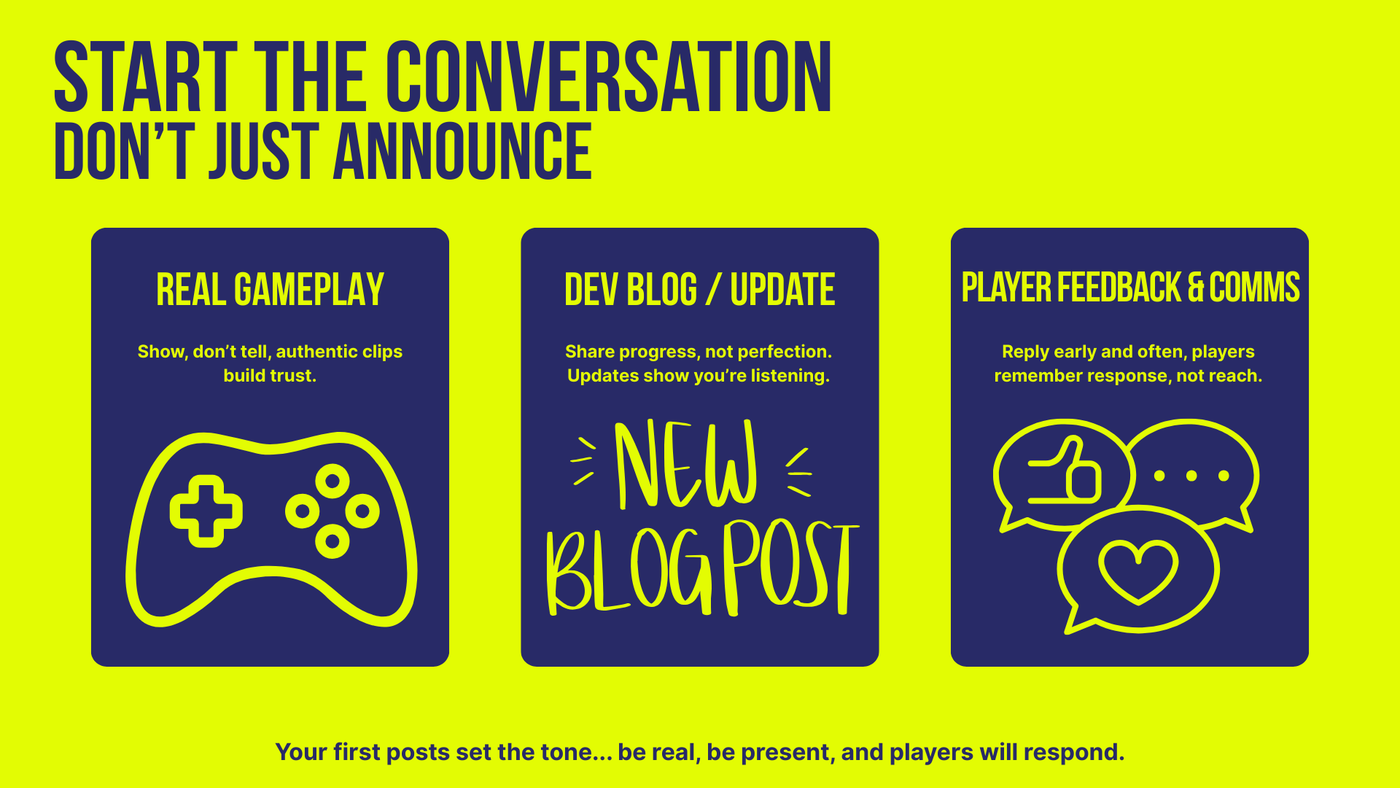
Choose one bounded action that fits the community's norms and your team's capacity. The observable result should match the purpose of the test. If you want to learn whether a mechanic creates discussion, look for questions, comparisons, and follow-up conversation. If you want to learn whether people enjoy creating with a system, look for examples, remixes, or requests for tools. A follower increase may be welcome, but it is not enough to answer either question by itself.
Close the loop
Participation includes response. If people ask questions, offer ideas, identify problems, or make something, acknowledge the effort and continue the useful exchange. Do not ask for feedback that the team has no intention or capacity to consider.
At the end of the observation window, record:
- What happened
- What surprised you
- Which signal supported or challenged the hypothesis
- Whether you will continue, adjust, or stop
- What you will test next
One test rarely proves a channel is right or wrong. Its value is that it creates better evidence for the next decision.
Your move
Choose one focus campfire, assign its current Hunt Zone, and write the evidence for your choice. Then define one action for this week, an observation window, an expected result, and the decision you expect to make after reviewing the evidence.
↳ Your actionChoose one Hunt Zone and one action to run this week, including an observation window and expected result.
↳CONCLUSION · 15–25 min to build · revisit after your test↳CONCLUSION·ARTIFACT TASK·15–25 min to build · revisit after your testStart/Resume Hunt Map
Turn your observations into a one-page decision record covering who, where, what evidence, what focus, and what one-week test.
Start/Resume Hunt Map
Turn your observations into a one-page decision record covering who, where, what evidence, what focus, and what one-week test.
Start/Resume Hunt Map
Turn your observations into a one-page decision record covering who, where, what evidence, what focus, and what one-week test.
Start/Resume Hunt Map
Turn your observations into a one-page decision record covering who, where, what evidence, what focus, and what one-week test.
You now have a practical path from an assumption to a test:
- Define the likely players for the game.
- Find candidate campfires where related people already gather.
- Listen for conversation, relationships, contributions, and stewardship.
- Choose a Primary, Growth, or Explore Hunt Zone using evidence and team capacity.
- Run one bounded test and define the result you expect to observe.
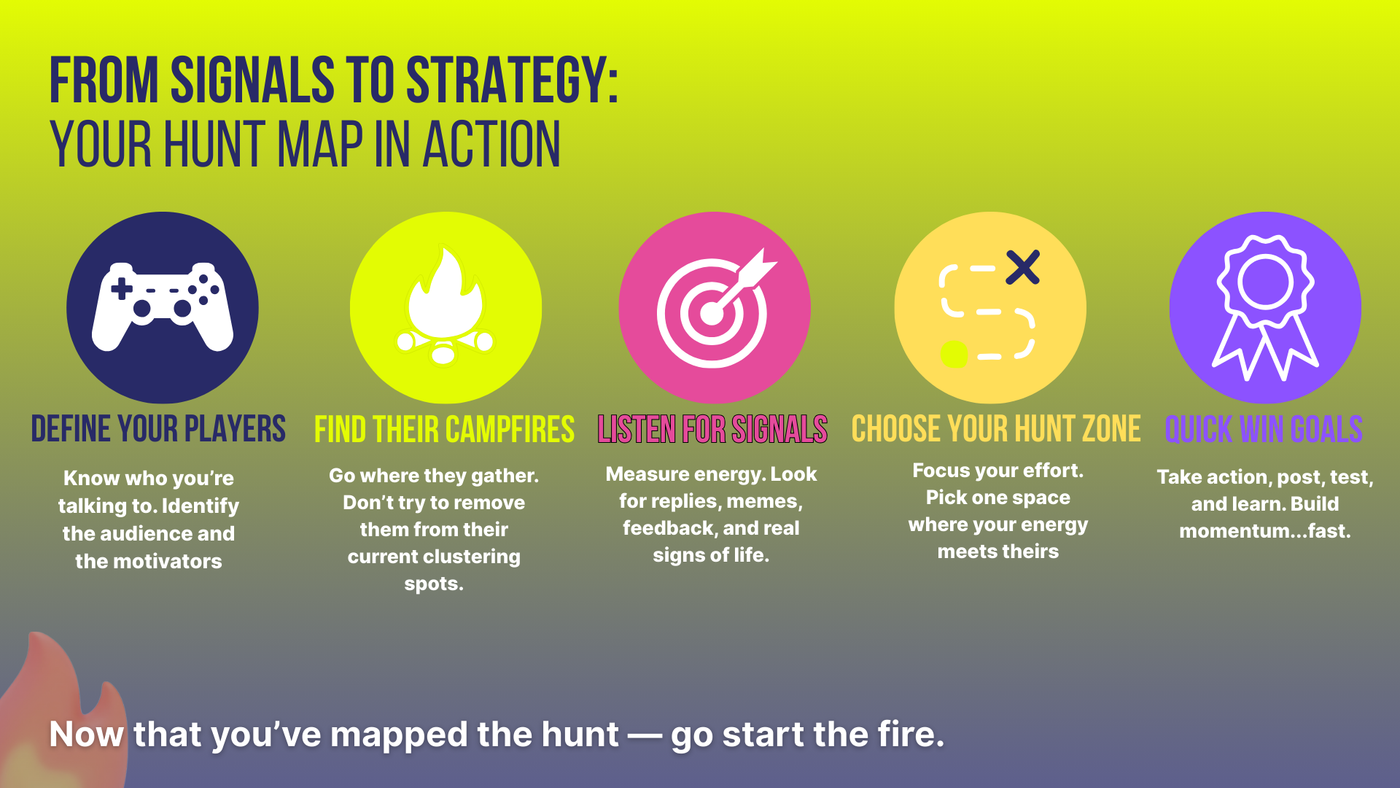
The Hunt Map turns those steps into a one-page decision record. It is not a forecast and it does not certify that you have found the perfect community. It helps you show why a space deserves attention, what remains uncertain, and what your team will learn next.
An effective Hunt Map is specific enough that a teammate can act on it. It names a player hypothesis instead of a vague audience, records observed evidence instead of only intuition, and sets a real observation window instead of an open-ended promise to "engage more."
Treat the Hunt Map as a private working document. Use public or appropriately anonymized observations, and do not include private messages, personal member data, or non-public invite links. If you later share a conclusion publicly, check the source community's rules and remove identifying details.
Assessment and scoring
The Pack assessment contains five objective questions worth one point each and one optional Hunt Map written entry worth one point. The passing threshold is 80%.
With six total points, five points rounds to 83% and passes. Four points rounds to 67% and does not pass. You can pass without the written entry by answering all five objective questions correctly. The Hunt Map is required for a 100% score.
The written entry point is awarded when the entry meets the 120-word minimum. It is not a human quality grade and it is not peer-reviewed.
Final practice
Complete the Hunt Map for a real or imagined game. Then take the five-question quiz. As you begin your one-week test, keep listening deeply, participate with care, and recognize the people who contribute. Return to the Hunt Map after the observation window and revise the decision with what you learned.
Complete the optional Hunt Map, then take the Pack quiz.
Build your Hunt Map.
Define the players you are looking for, compare up to three campfires, then choose one bounded test. Your answers become the first section of your Operator Gameplan.
Saved in this browser for 30 days. Anyone using this browser profile could see it. Sign in to add it to your private gameplan and use it across devices.
Do not enter usernames, private messages, invite links, or personal member data.
Loading your Hunt Map...
Take the Find Where Your Players Gather quiz.
5 short questions + 1 written artifact. Passing earns 25 credits toward your Player Driven profile.